


Growing up in a small community, within a small community, people talked. You talked through your problems and differences, your similarities and likes, your needs and wants. All of this was bi-directional, even omni-directional. People had differing views; in a small town most knew who thought what, and it was OK. They were still neighbours, friends and customers. For the most part we all came together to help the community grow — together, for everyone.
Sometimes the talk was a bit much; you often felt like everyone knew everyone else’s business. There is a sense of security within that kind of atmosphere. Sure, shit happened and some of it stuck with me for a long time, but it wasn’t as common — I don’t think anyhow.
At a state and federal level, leaders talked, made deals, worked together quite a bit; in general it was mainly about running the state or the nation. The news was just the news — it was on once or twice a day, that was it. It seemed more straight too, like: here are the facts, this is what happened, this is what’s going on. Less interpretation.
I didn’t really notice the shift. I was injured around the time things started to move away from what I had grown up with, and spent a number of years going to and from doctors’ appointments and getting treatments. Those years away from the world mean I missed the turn as it happened. But from what I can tell, around the early to mid 2000s things started to nose dive, and we found ourselves in either a blue corner or a red corner, with no referee.
This had started some time beforehand in America and is especially true today. Australia is less intense than America, but we do seem pretty keen to be just like her. In Australia only 12% trust politicians,¹ a figure that seems to be steadily declining since the late ’70s,² and 71% feel politically voiceless.³ We have two major political parties, and within both it is standard practice that if one party says one thing, the other says the opposite. If the Prime Minister announces a new policy, the opposition will denounce it — and the Prime Minister for even contemplating it. Independents seem rarely to actually be independent; one day they’ll see value in one side’s policy, the next in the other’s. Everyone is out there taking pot shots at each other. I can’t think of a single time I have heard a politician say, “Mate, that’s a bloody good idea, but you know what, if you add XYZ it would be a ripper,” about a policy from the other side.
The news — now known as News Media — is available 24/7 via phone, PC or TV. In Australia only 38% of people trust the media.⁴ You now choose your news based on what brand best represents your voice. Some lean one way, others another, others further afield. There are only a few owners for the major brands, with some independent outlets fighting to survive. Because the water is so muddy on what lean a brand has — or even a single article — there are sites that will curate your news from multiple sources and flag the angle from which each story is being reported.
News is about clicks. It’s about garnering your attention and holding it, because the longer you look, the more you see — the ads, and that’s where the money is made. A news article becomes a big shiny thing; the headline, more than ever, has to capture your attention. I’ve fallen for this a few times of late. One outlet I use regularly has started publishing what looks like a new article — say, about the war in Iran — and when I click through, it’s the exact same story I read that morning. They’ve just changed the headline, either to trick people into clicking again or because the original wasn’t pulling enough traffic. I find myself thinking: if I can’t trust them with a headline, how do I trust them with the content?
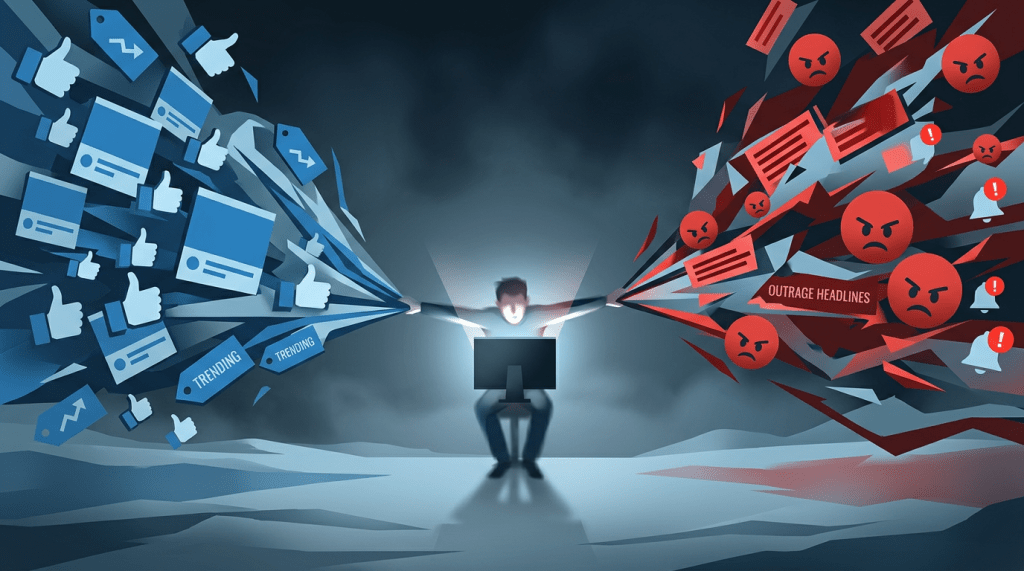
Then there is social media. I think this might be the biggest culprit polarising the population of them all. “The algorithm” has become a catch-all term — if you say it, pretty much everyone knows what you’re on about. Every social media platform has one, drawing on information collected from other platforms and websites to shape what appears on your feed next.
The goal of the algorithm is much the same as a news media website: keep you on the platform, engaged and consuming. They are just more sophisticated about it. Using data it collects on you — what posts you stop to look at, what videos you watch, how far through you watch them, what you like, who your friends are and what they engage with — the platform targets more of the same your way, increasing the probability that you stay longer.
If you indicate a preference for a topic, opinion or set of beliefs, your feed fills with content around those things. The more time you spend, the more data you hand over, and the more precisely it can identify exactly what within those topics keeps you hooked — and push that harder.
Unfortunately, humans are an odd bunch. Negativity bias combined with desensitisation means we tend to drift toward increasingly negative content. What starts as “I’d rather that didn’t happen” becomes “I hate it, and the people who do it.” That’s an extreme end of the spectrum, and it takes time to get there — but everyone sits somewhere on that spectrum. The algorithm, working alongside human nature, will nurture whatever you bring to it, right on up.
For me, I know I lean left. I try to remain as unbiased as possible and view ideas on their own merit, and I try to carry that into how I engage in comments. I often see real sense in right-leaning policies, and sometimes little in left-leaning ones. Sometimes, from both sides, I can get behind what they’re trying to achieve — it’s the method where I have a problem.
Because I lean left, my algorithm feeds me predominantly left-leaning content; even the “educational” videos tend that way. But it is my algorithm — something I have cultivated over the years. I used to wonder how it developed a sense of who I was in the first place, how it knew what to show me early enough to get me hooked. I figured it out: when a platform asks you to add friends during sign-up, that’s part of it. The people in your community help shape who you are, and in turn they help shape the first outputs of your algorithm. If you’re friends with these people and they like this stuff, you’ll probably like it too.
Knowing I lean left, and knowing this is my algorithm to train and manage, I skip videos that push further left than I want to go. I skip what doesn’t interest me, what doesn’t appeal, what I disagree with — and I do this consistently. I don’t let my curiosity pull me down rabbit holes. I don’t use social media to explore what other parts of the internet are getting worked up about.
That isn’t to say I’m unaware of other views and beliefs. I just don’t indulge them on social media, because the slope is too easy — one video a little more extreme, then another, and suddenly I’m holding a position I’ve been nudged into without really examining it.
Social media is not an educational platform. It can be a launch pad — you might see something that sparks genuine curiosity and go looking for real information — but the credibility of what you encounter there is questionable. It should be one of the places you start, not your start and finish.
The algorithm, when you maintain it deliberately, can be a good thing. It will serve more and more content you actually enjoy. For me, that’s the point — when I use social media, it’s to connect with people I know or for enjoyment, not indoctrination.
But make no mistake: you are up against teams of engineers, behavioural scientists and psychologists, all working together to keep you hooked. What I’ve described is how I manage that. It may not work for you — your circumstances, your needs, your relationship with these platforms may be different.
I do think there should be structural protections — mechanisms that place real limits on the algorithm, so that instead of interpreting your passive engagement as a signal to push you further in one direction, it requires you to actively tell it where to go. This is adjacent to the algorithm and AI transparency reforms currently being discussed, but goes further: rather than simply disclosing how the algorithm works, platforms would be required to give users genuine, explicit control over its direction, or be forced to curtail how far down the rabbit hole it’s permitted to take you.
For a long time we heard about radical Islam — it’s not a term I hear as often anymore. But I think we are seeing a shift toward radicalisation in other areas, particularly politics, and it is accelerating. The dynamic is the same: a community under pressure, a clear enemy, an identity built on opposition.
Immigration has become one of the biggest arenas for this. In America, the Trump administration and ICE have been portrayed — and in documented cases have acted — in ways that are genuinely alarming. In Australia we have Pauline Hanson, a Senator who wore a burqa into the chamber during Question Time to provoke outrage.⁵ Her primary platforms are immigration and First Nations peoples. To my mind, her entire method is built on polarisation — pushing one group in one direction and another group in the opposite. That’s not to say I disagree with every position she has taken, but you don’t have to manufacture division to make a point.
We need to be clear-eyed about how these forces combine. News media reporting from its own bias, social media reinforcing our own bias, and politicians who stoke fear and push agendas — together, these things align to radicalise the population against itself. Divide and conquer.
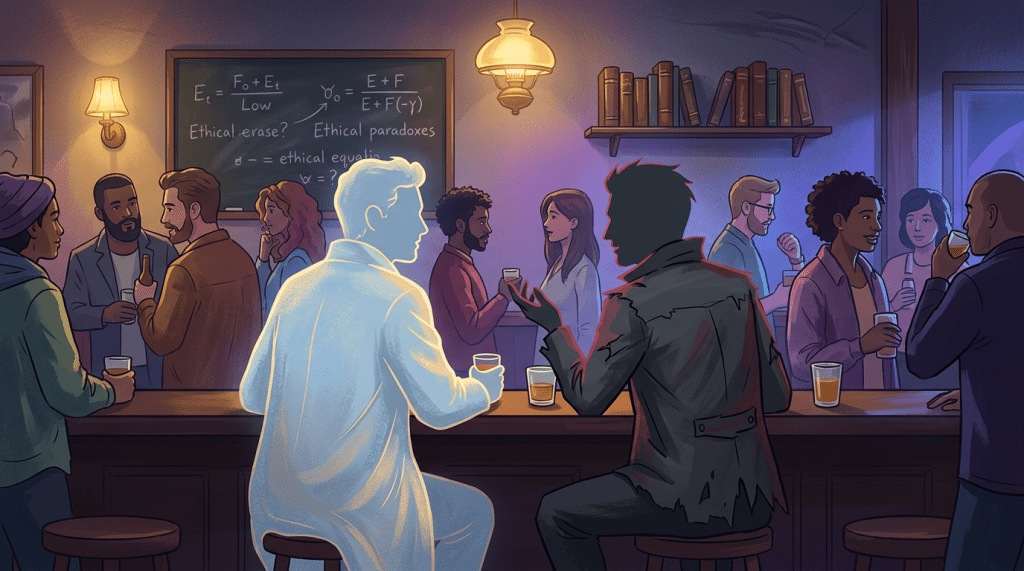
We have always lived in communities. We needed them to survive. Now more and more people turn to the internet to find theirs — to find like-minded people who get them. In the community I grew up in, there wasn’t really anyone like me. I had things in common with some people, but for the most part I was on the outer, particularly in my own age group. The internet offers something that town never could: a choice.
Looking back, not having people exactly like me kept me grounded. It allowed me to grow in different directions, exposed me to things I didn’t know and some things I wasn’t interested in at all. When I did the things that felt truly like me, that made them more special. Life in a small community within a small community was hard, and truthfully I left as fast as I could. But it shaped the person I became, for all its flaws — and there were many. If I yelled, I didn’t just hear the same thing flung back at me. Too often now, that’s exactly what we get: our own bullshit, echoed. And if we’re not hearing it, we go looking for it.
An online community can be a genuinely good thing. I’m part of a few, though not deeply invested in any of them. They offer real benefits, particularly for people in minority groups or those limited by geography. When an online community supplements your real-world one, it can be valuable. When it replaces it, that’s where the concerns start.
When you go out with a group of friends, each person brings something different, and the group is better for it. That’s the kind of experience worth looking for online too. If everyone is bringing the same thing, if the group is just building and reinforcing its own philosophy, if you’re becoming more like everyone else rather than more yourself — then what? Is the group special anymore? Are you?
You’ve become one of the crowd.
If that crowd is a knitting circle, that’s great. If they’re sewing all the squares together into German WWII banners, then maybe less so.
References
¹ Global Trustworthiness Index 2022. Ipsos, 2022. https://www.ipsos.com/en/global-trustworthiness-index-2022 (Australia figure of 12% citing politicians as trustworthy is reproduced in The Civic Health of Australia, Australian Leadership Index / Swinburne University, June 2024: https://australianleadershipindex.org/wp-content/uploads/2024/06/The-civic-health-of-Australia_Wilson-Kowalski-Demsar_FINAL_June-2024-1.pdf)
² The 2019 Australian Federal Election: Results from the Australian Election Study. ANU / Australian Election Study, 2019. https://australianelectionstudy.org/wp-content/uploads/The-2019-Australian-Federal-Election-Results-from-the-Australian-Election-Study.pdf (see also ANU press release: https://politicsir.cass.anu.edu.au/news/australian-election-study-2019-released-trust-government-hits-all-time-low)
³ Satisfaction With Democracy and Political Efficacy in Advanced Economies. Pew Research Center, 6 December 2022. https://www.pewresearch.org/global/2022/12/06/satisfaction-with-democracy-and-political-efficacy-in-advanced-economies-2022/ (Australia 71% figure reproduced in The Civic Health of Australia, Australian Leadership Index, June 2024)
⁴ 2024 Edelman Trust Barometer — Australia. Edelman, March 2024. https://www.edelman.com.au/sites/g/files/aatuss381/files/2024-03/Australian-Edelman-Trust-Barometer-2024_Top10.pdf (see also BBS Communications summary: https://bbscommunications.com.au/fear-and-mistrust-could-stifle-australian-innovation-2024-edelman-trust-barometer/)
⁵ Pauline Hanson wears burqa to Question Time in the Senate. ABC News, 18 August 2017. https://www.abc.net.au/news/2017-08-18/pauline-hanson-wears-burka-to-question-time-in-the-senate/8816886 (see also The Guardian: https://www.theguardian.com/australia-news/2017/aug/21/pauline-hansons-burqa-stunt-undermines-social-cohesion-counter-terrorism-police-say)
 Arctic Zombie
Leave a comment