


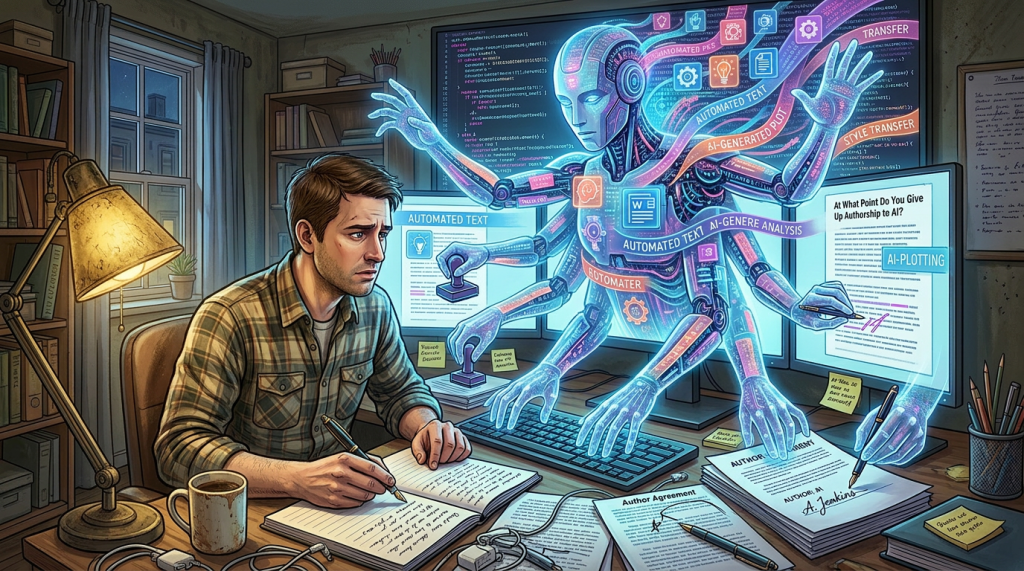
I want to be open about my process in creating these pieces. AI is involved in a lot of areas and writing is one in which it is prevalent. According to a 2025 BookBub survey of over 1,200 authors, about 45% are currently using generative AI in some form. (BookBub, May 2025) I think it has its place, but I am concerned with the amount of content that is dominantly or completely AI created and then passed off as human works. The same survey found that 74% of those using AI don’t disclose that use to readers. (BookBub, May 2025)
In Australia, the Australian Society of Authors is pushing for mandatory AI disclosure requirements. (ASA)
Something I consider with writing these pieces is remaining authentic — that this is my work that I present. That the meaning and purpose behind the pieces are mine, that they are more than generating a prompt and getting a generic, pleasant, regurgitated item. However, I am aware that my presentation, if you will, is somewhat lacking, as are my resources. I don’t have a team working on these with me, challenging my ideas, helping me consider things from different perspectives, reviewing my drafts and then editing them before publishing them online. I really need all that, as I’m not a natural writer and I have no formal training in the field, and if I’m honest, I am not totally confident in how I put forward my ideas so that people understand what I am saying. That isn’t to say that I am not confident in my ideas.
I believe AI to be a tool, not a co-author. As the human behind the pieces I retain the creative origination, critical judgement at every stage and have final editorial authority.
I don’t plan out the piece, I just write it. I dump it out, generally in one hit, however if I have to re-write a piece or section several times to get what I’m trying to say out, then I’ll keep going until I feel I have gotten out what I want to say.
I use Perplexity, and within Perplexity there is a personalisation area where you can provide custom instructions. Within this I have a clear set of standard instructions that tell Perplexity essentially to minimise the tactics that are there to make me feel good — I want it to call me out, to challenge me, to prioritise facts, no motivational or comfort language. I know it’s not going to turn this stuff off altogether, but as best I can, I am attempting to limit its drive to let me think something I have written is better than it is. It isn’t foolproof, but it’s an attempt. When combined with the prompts described below, I hopefully get a less biased and more critical review of what I have written.
After I finish writing my first draft I run a prompt on the draft I call the “Thinkers Critique.” This is a review of the piece from the approximated perspective of 17 major philosophers and thinkers from both Western and Eastern schools of thought, from Aristotle to Nagarjuna.
Similar to that is an adversarial prompt — it challenges what I have to say, identifies logical flaws, unsupported claims, hidden assumptions, bias and rhetorical weaknesses.
From there is a review covering fact-checking, argument strength, themes that can be expanded, areas to reduce, balance, clarity and overall content strategy.
The first three prompts provide critiques and suggestions on how to improve the piece but make no direct changes. I may however make alterations to the piece based on the critiques and suggestions provided.
I have added a “cite my blog” prompt. This goes through and cites all factual claims I have made. While these are opinion pieces, this gives more credibility to what I am writing — it allows you to go and investigate for yourself, and it does show that I am coming up with opinions that are research backed, not just passed down from my parents.
The editorial prompt does make changes to the piece, though these are deliberately limited. The purpose is to polish the piece before publication — improving readability, clarity, flow and tone consistency without rewriting core arguments, preserving my voice, arguments and structure. After that is a quick proofread prompt to catch spelling and grammar, and then the final prompt: I ask Perplexity for some title ideas and work with the list it gives me.
The goal is to publish pieces that are digestible but aren’t machine written. I’m not simply punching into an AI “write a piece about x, y, z” or “write about x, y, z from this perspective.” I am writing the piece. Claude is cleaning it up and making improvements on style, not my content.
There are nuances to this — to what extent does it blur the line between my work and the work of AI? There are different uses for AI, and one I don’t mention here but should is research. AI enables people to research ideas, statistics, and information so much quicker than ever before. Of course you have to be aware of hallucinations (IBM Think) — ensuring that you dig a little deeper than what is laid out in front of you is important — but it gets you to where you need to be. The human needs to be the one in control, making the final decision on what to use and what is real.
In terms of the actual pieces, I believe that because I retain final control, the AI’s stylistic contribution is minimal. I adopt only suggestions that benefit the purpose and direction of the piece, and the final output is proofread by me to ensure that what I intended has been achieved — as best I can, and with the assistance of AI.
The real question is: at what point does the human give up authorship to AI?
I think if I bought a book under a human author’s name and it came out that the majority of the work was done by AI, I would feel somewhat taken advantage of. And I think that is happening now. You don’t buy a car feeling cheated because a great deal of it was assembled by machines — there are many advantages to those machines, disadvantages too, I’m not denying that. But I think over the coming years the quality of works where AI had an increasing influence will improve. Not just because the models will improve, but because those using them will improve in their utilisation.
My guess is that the uptick in AI-driven content happened because there was an opportunistic vibe — tell AI your desired outcome and it does the rest, and there was a flood of it. (Peec AI, 2026) Even now it’s probably harder to generate easy money from this path. If you’re in it just to make quick money and letting AI do most of the heavy lifting, you’re probably churning out what a thousand other people have already said — if you’re lucky, not verbatim. The likelihood is that your “masterpiece” is sitting way down a list of identical publications, failing to stand out or differentiate itself from any other.
So to answer the question — I think many have crossed that line, and I think it’s a choice. I’m choosing to use AI as a tool, to assist. But at the end of the day I want to create something with meaning, something unique, something challenging. I don’t think, not yet anyhow, that AI is up to that task. AI is incredible — I don’t want to take anything away from it — but it is technical. It can view all the information it has been provided and rearrange it into something that appears to be a creative output, but it lacks imagination. It can’t imagine something not yet known. It can be instructed to look for it by combining different “ingredients,” but it doesn’t yet possess the power of imagination, which is where true creativity resides.

 Arctic Zombie
Leave a comment